U-KOMI

What is UGC? A Complete Explanation of User Generated Content [2026 Edition].

What is UGC? A Complete Explanation of User Generated Content [2026 Edition].

[Updated January 2026] This article is the 2026 edition of our comprehensive guide, featuring the latest case studies on UGC utilization and information on AI capabilities.

UGC stands for User-Generated Content. It refers to content created by general users, such as reviews, word-of-mouth comments, and social media posts, and has become an essential information asset in marketing. Authentic consumer voices not only enhance credibility and appeal but are also gaining attention as creative content due to the wide range of ways they can be utilized.

While many brands have recognized the influence of UGC and are actively adopting it, we are entering a phase where the quality of UGC is being scrutinized due to technological advancements and the diversification of consumer purchasing behaviors and needs.

In this article, we’ll provide a comprehensive overview of UGC—from basic concepts to implementation strategies, risk management, and future prospects—using the latest case studies and data!

1. What is UGC? An Easy-to-Understand Explanation for Beginners

—Basic Concepts of UGC

UGC stands for User-Generated Content. Unlike advertisements or posts created by brands, it refers to content produced by ordinary users.

—Specific Examples of UGC

Typical examples of UGC include reviews and testimonials posted by consumers after purchasing a product, as well as visual content such as text, photos, and videos shared on social media platforms like Instagram, TikTok, and X.

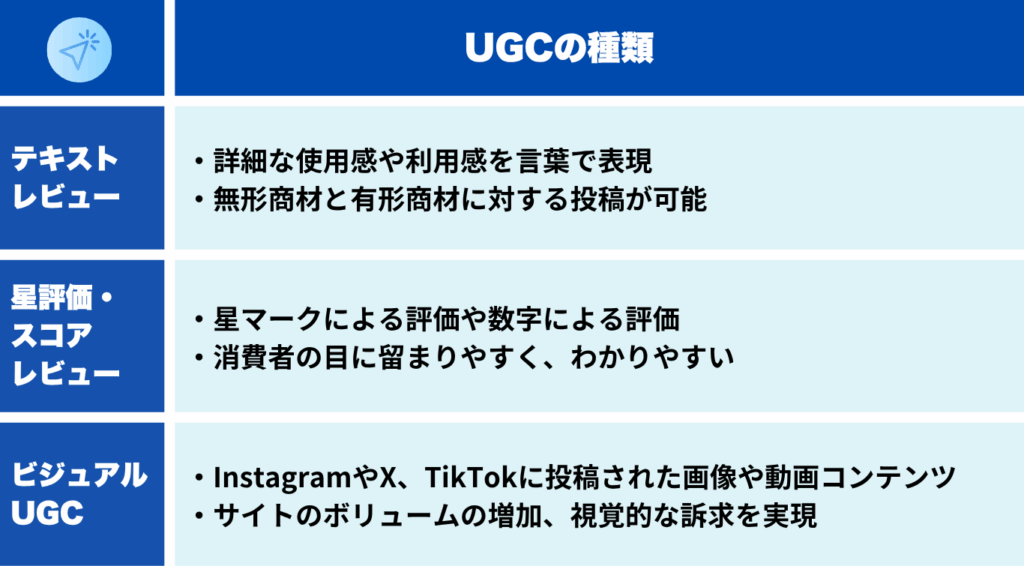
—Types of UGC

A. Text Reviews

・Text allows users to describe detailed experiences and impressions that photos or videos cannot fully convey. ・Since
it is text-based, reviews can be posted for both intangible and tangible products.

B. Star Ratings and Score Reviews

・These are reviews that use star ratings or numerical scores.
・Because this is a simple evaluation method, it is easy to understand and catches consumers’ attention.

C. Visual UGC

・This refers to image and video content posted on Instagram, X, and TikTok
. ・With the widespread use of social media, users tag posts to promote and evaluate products and services. ・Photos and videos uploaded to social media
can be featured on e-commerce sites as visual UGC, increasing the site’s content volume and enhancing its visual appeal.

2. Why is UGC gaining attention now?

—The Importance and Benefits of UGC

UGC, such as reviews and word-of-mouth, is referred to as customer evaluations or VOC (Voice of the Customer). It is positioned as a reliable information asset—the so-called "voice of the customer"—that is indispensable for marketing.

Click here for more details on VOC

Implementing UGC offers a variety of benefits. By allowing consumers to research products and services in advance, it alleviates their purchasing anxiety and encourages them to buy. In other words, it can be leveraged as social proof (*1).

It also helps lower return rates, contributing to a reduction in workload for brand staff.

Furthermore, when customers discover new ways to use products or services and share those ideas, it serves as a catalyst to boost appeal and has the potential to go viral on social media. Companies can reap these benefits as actual revenue without spending money on advertising.

UGC continues to attract attention as consumer-generated content that appeals to both companies and consumers.

*1 Known as "social proof." A psychological term proposed in the 1980s by American psychologist Robert B. Cialdini. It refers to the tendency for people to refer to or be influenced by the social evaluations, opinions, and behaviors of those around them in order to validate their own judgments, thoughts, and actions.

—The Appeal of UGC Content

UGC Content and Visuals UGC content is created and shared based on customers’ real-life experiences. This makes it more trustworthy than corporate advertisements or posts, helping users visualize what it’s like to use the product or service.

Furthermore, since there are no constraints imposed by the brand, creators can freely produce and express content. This allows for a wide variety of creative approaches, resulting in visually appealing content that effectively communicates the appeal of products and services.

3. What Are UGC Tools?

—Features of UGC Tools

Simply put, a UGC tool is a tool designed to display customers’ authentic voices—in the form of “word-of-mouth” or “reviews”—on a company’s website. However, the functions vary widely depending on the tool. The role of a UGC tool is not merely to display reviews; it is a compelling marketing tool that offers a wide range of benefits, including the creation, collection, and utilization of reviews.

For example, by utilizing UGC such as word-of-mouth and reviews, companies can analyze areas for improvement in their products and services as well as key promotional points, enabling them to respond to customer needs in real time. Additionally, these tools can be used to measure the effectiveness of marketing campaigns and manage brand reputation, allowing for a swift response to market trends and competitor activities.

Currently, UGC tools can utilize visual content—such as photos and videos posted on social media platforms including Instagram, TikTok, and X—as visual UGC, offering functionality that goes beyond simply displaying text reviews. By leveraging visual reviews in addition to traditional text reviews, companies can enrich their website content and engage customers through visual appeal.

Methods for collecting UGC vary by tool—such as dynamic email campaigns, hashtag searches on social media, or integration with QR codes at physical stores—but there are various approaches available.

—Types of UGC Tools

A. UGC Tools

These are review tools that display traditional star ratings or text-based testimonials and reviews. Their features vary by tool, and they specialize in different areas within the categories of generating, collecting, analyzing, and utilizing testimonials and reviews. Other features include Q&A functionality, marketing campaigns, tools specialized in review collection, tools specialized in collecting social media posts, and tools designed for physical stores.

B. Visual UGC Tools

Visual UGC tools are relatively new tools that collect visual content—such as photos and videos posted on social media platforms like Instagram, TikTok, and X—using features like hashtag search, and display them on a company’s website in an album-like format.

Since UGC tools are currently evolving at a rapid pace, it is essential to stay updated on the latest features.

Learn more about visual UGC here

—Benefits of Implementing UGC Tools

The benefits of implementing a UGC tool include the following:

✔︎ Improved conversion rates (CVR) through landing page optimization ✔︎ Improved click-through rates (
CTR) by displaying product review information in Product Listing Ads (
PLA) ✔︎ Increased engagement through communication with
customers using the reply function ✔︎ Building the “credibility” of review management from a third-party perspective

By implementing UGC tools and visual UGC tools, you can publish text content as well as visual content such as photos and videos. This enables the aforementioned benefits to take effect, strengthening your company’s website and increasing its appeal. Ultimately, this can be leveraged as a rich component of the SEO strategies that many marketers work on daily.

Furthermore, the recent proliferation of fake reviews” has become a major issue, and the “quality” and “credibility” of reviews are under intense scrutiny. It is no longer sufficient to simply post reviews; proper review management is essential. In this regard, UGC tools can help achieve “transparency in review management.”

Click here for details on improving review credibility

Since UGC tools vary in features, functionality, and pricing, it is important to select and utilize a tool that aligns with your e-commerce site’s marketing goals.

4. UGC Strategies

— Landing Page (LP) Optimization

Displaying reviews on landing pages (LP) increases the site’s content volume and enables the creation of visually more engaging pages. Some UGC tools allow you to customize how reviews are displayed to match your site’s design, rather than simply showing them as-is. If you prioritize the site’s appearance or SEO effectiveness, we recommend comparing and evaluating these options.

- CVR Improvement

When we measured the effectiveness of landing pages with reviews versus those without, we confirmed that landing pages with reviews achieved a 1.2-fold increase in conversion rate (CVR) (based on our internal research). We have also received numerous reports from our users stating that their conversion rates have more than doubled.

—CTR Improvement

Because reviews utilize star ratings, text, and visual content, they are more likely to catch the eye of consumers seeking detailed information. When users search for the same product name, sites with reviews offer greater visual appeal. Displaying reviews also causes star ratings, numerical ratings, and the number of reviews to appear in PLA (Product Listing Ads), which naturally improves CTR (Click-Through Rate).

- Increased Engagement

Responding to reviews posted by customers increases engagement.Many users now primarily shop online via smartphones rather than PCs, and since they scroll through pages quickly, content is often overlooked. However, displaying reviews can capture consumers’ attention and make them pause their scrolling. As a result, time spent on the site increases, and engagement rates rise. Depending on the UGC tool, you can track the impact of reviews on orders and analyze engagement rates, making it possible to utilize this data for measuring marketing effectiveness.

- Reply Function

Some UGC tools include a feature that allows staff to reply to reviews posted by customers. By responding directly to customers’ questions or concerns in the reviews, businesses can achieve one-on-one customer service online that mimics the experience in a physical store, thereby boosting customer loyalty (*2).While replying carefully to each review individually takes time and increases staff workload, some UGC tools offer automated reply generation features that can help reduce this workload. Additionally, these interactions can be displayed as content for customers with similar questions or concerns, serving as a strategy to reduce the number of inquiries.Beyond simply displaying reviews on a dedicated page, some companies also publish them on their website’s “Frequently Asked Questions” page to reduce the workload associated with handling inquiries.

*2 Here, “loyalty” refers to customers’ attachment to and positive feelings toward the brand.

—Utilizing Surveys

When requesting reviews from customers who have purchased your products or services, you can set up questions—in addition to the open-ended review section—that include points the store wishes to utilize for marketing initiatives. Customers can answer these questions at the same time they write their text review, allowing you to use this as a survey. The key here is to keep the number of survey questions reasonable so that even busy users can answer them easily, and to use multiple-choice formats where appropriate.For example, in the case of online food retailers, you can ask customers to rate the number of times they’ve purchased, how they use the product, taste, convenience, and satisfaction. Additionally, offering rewards for actions such as posting reviews, attaching photos or videos, or sharing on social media makes it easier to collect UGC. By categorizing and displaying the responses directly within the reviews, customers can easily identify and view reviews from users similar to themselves, resulting in a highly effective marketing impact.

—UGC and Visual UGC

By displaying UGC—such as photos and videos collected via social media platforms like Instagram, TikTok, and X—on your owned media channels, consumers can access more detailed information about your products and services.For example, in the case of apparel UGC, if a user’s post includes not only height and weight but also trendy body type analysis results or personal color recommendations, customers can compare these details to their own body type and verify how the item actually fits. This helps prevent mismatches in online shopping and reduces the workload associated with returns.

Additionally, by utilizing visual UGC features, brands can publish not only content from general users but also photos and videos created by brand staff, clearly labeling them as "staff posts." This allows for more detailed and easy-to-understand explanations of products and services, helping brands differentiate themselves from competitors. For brands with physical stores, visual albums can be categorized and published by location, enabling them to convey the appeal of both online and in-store experiences using review tools.Since some tools allow reviews to be categorized by product, you can provide information from a more consumer-centric perspective.

By integrating with Instagram, you can not only drive new traffic to your website’s product and service pages but also increase the likelihood of future organic searches by keeping customers engaged there. Thus, effectively leveraging visual UGC can help boost your conversion rate (CVR).

5. UGC and Marketing Strategy

—What Is UGC Marketing?

UGC marketing refers to a marketing strategy that generates revenue by collecting content created by consumers and utilizing it as a trustworthy information source for customers.

Since it delivers results without requiring high advertising costs, it offers excellent cost-effectiveness. With CPAs currently skyrocketing, now is the ideal time to start implementing these strategies. In this section, we will explain various marketing strategies that utilize UGC marketing.

—Creating Loyal Customers

Loyal customers are a segment of consumers who have a strong attachment to a specific brand, product, or service, and who continue to purchase them repeatedly over a long period of time. Unlike high-value customers who make frequent purchases with high spending amounts, loyal customers are characterized by a specific attachment to the brand, product, or service. They can be described as “die-hard fans” who are unlikely to switch to other brands easily.

Creating loyal customers has become a critical challenge in modern marketing. This is because fostering loyalty enables companies to secure consistent, stable revenue and build long-term business plans. Additionally, loyal customers actively promote the brands, products, or services they love to other customers who are not yet familiar with them. Their reviews carry high credibility, making it easier to acquire new customers.

Click here for examples of customer loyalty improvement initiatives

—One-to-One Marketing

To create loyal customers, several marketing strategies must be implemented. One of these is one-to-one marketing. As the name suggests, one-to-one marketing is a marketing approach that involves communicating with customers in a way that is tailored to the needs of each individual.

To create loyal customers, it is important to provide information from the customer’s perspective that truly resonates with them. This communication builds trust and a sense of security, serving as the catalyst for purchasing products or services.

Examples include sending emails with information likely to interest the customer or implementing a recommendation feature that displays related products based on their purchase history.

Additionally, actively providing post-purchase support helps foster customer loyalty. By using UGC tools to respond to customer reviews, customers are more likely to feel positively about posting reviews, increasing the likelihood that they will post another review during their next purchase.

—Fan Marketing

Fan marketing is a strategy that cultivates brand fans who love and actively promote your products or services, leveraging their influence for marketing purposes.

Fans are more enthusiastic than loyal customers; they use and promote products and services with a stronger sense of affection. In recent years, some companies have begun developing brand-specific communities to foster loyal customers and fans, providing a “space” where customers can communicate with one another.

Within these communities, existing brand loyalists and fans are actively engaging with one another—exchanging opinions and gathering information about the brand.

UGC tools can serve as one such community. Reviews submitted by loyal customers and fans through UGC tools are trusted and authentic. By displaying these as top reviews, they can positively influence not only existing customers but also new ones.

Furthermore, by utilizing UGC tools as a community where they can generate and share ideas, brands can positively influence not only new customers but also various customer segments, including high-value customers, and have the potential to cultivate new loyal customers and fans.

6. Risks and Countermeasures to Be Aware of When Utilizing UGC

—UGC and Negative Reviews

When collecting UGC, negative reviews are often posted. Since negative reviews can damage the image of your products, services, or brand, many companies may find this problematic.

In the case of negative reviews—such as complaints about a product or claims that the actual experience differed from expectations—publishing them may actually increase trust in the brand. In recent years, there has been a growing emphasis on the quality of reviews; if a site features only positive reviews, new customers may suspect they are “fake reviews.” Therefore, deliberately publishing lower-rated reviews can help establish the brand as trustworthyone that is transparent enough to share negative feedback—making it more likely for customers to use the site.

Furthermore, responding to negative reviews can make customers feel that their feedback is being taken seriously, which has the potential to boost customer engagement. By displaying this exchange alongside the review, it becomes easier to convey to other customers that the brand is sincerely committed to customer service, highlighting the importance of not ignoring negative reviews.

On the other hand, if defamatory comments or baseless negative reviews regarding products, services, or the brand are posted, they can damage the brand’s image and cannot be left unaddressed. In such cases, brands can efficiently manage the issue by utilizing the review visibility settings (public/private) built into review management tools.

By setting the review to private, it will no longer be displayed on the site. Additionally, tools like the UGC platform U-KOMI feature AI-powered automatic review classification, allowing you to set reviews to public, private, or pending. This reduces the workload on staff, enabling them to review private or pending reviews at their convenience. The ability to utilize such features is a distinct advantage unique to review management tools.

—Measures for the Pharmaceutical and Medical Devices Act (formerly the Pharmaceutical Affairs Law)

The "Pharmaceuticals and Medical Devices Act" refers to the "former Pharmaceutical Affairs Law" and is also known as the "Act on the Assurance of Quality, Efficacy, and Safety of Pharmaceuticals, Medical Devices, and Other Products." Its official title is "Act on the Assurance of Quality, Efficacy, and Safety of Pharmaceuticals, Medical Devices, and Other Products." The following is a quote from its purpose:

"Article 1: This Act shall establish the necessary regulations to ensure the quality, efficacy, and safety of pharmaceuticals, quasi-drugs, cosmetics, medical devices, and regenerative medical products (hereinafter referred to as 'pharmaceuticals, etc.')and to prevent the occurrence and spread of health hazards resulting from their use; to take measures regarding the regulation of designated drugs; and to promote the research and development of pharmaceuticals, medical devices, and regenerative medical products for which there is a particularly high medical need, thereby aiming to improve public health and hygiene. (*3)"

One reason this law is often cited as an issue in reviews is that it applies not only to companies but also to content posted by general consumers. Reviews regarding a product’s efficacy lack objectivity and cannot be regarded as guarantees of that product’s efficacy.

Consequently, while such reviews cannot be published because they violate the Pharmaceutical and Medical Devices Act, there may be cases where you wish to publish portions of the text written by customers that do not violate the Act. In such cases, by utilizing a review tool, you can hide only the text that violates the Act—the so-called “NG words”—and display the rest of the text as is.

*3 Ministry of Health, Labour and Welfare. “Act on Securing the Quality, Efficacy, and Safety of Pharmaceuticals, Medical Devices, and Other Products.”
August 10, 1960, https://www.mhlw.go.jp/web/t_doc?dataId=81004000&dataType=0&pageNo=1, (accessed February 3, 2025).

—Compliance with Stealth Marketing Regulations

“Ste-ma” is an abbreviation for “stealth marketing,” referring to the act of promoting products or services while concealing the fact that it is an advertisement. For example, this includes promoting a company’s products or services using reviews in a manner similar to so-called “planted reviews.”It also includes paying popular influencers to promote products without disclosing this fact. This undermines the credibility of reviews, which are supposed to be trustworthy precisely because they appear to be third-party posts. If stealth marketing is exposed, it damages public trust in the company.

It is important to clearly disclose any self-promotion or promotion involving the exchange of compensation in order to maintain social trust.

 7. Synergy Between UGC and SEO 

—Impact on Search Engine Rankings

Since reviews and word-of-mouth are based on consumers’ direct experiences, they are referred to as primary information (*4). Because this aligns with E-E-A-T (*5)—a concept frequently mentioned in Google SEO strategies—it becomes a factor in earning a positive evaluation from Google.E-E-A-T stands for Experience, Expertise, Authoritativeness, and Trustworthiness.

Publishing UGC not only increases the volume of keywords and content but also keeps the content fresh by continuously collecting reviews and updating information. Since this information is presented from the user’s perspective, it aligns more closely with users’ search goals, intentions, and keywords, leading to improved CTR and longer time spent on the site—allowing you to see tangible results from your SEO efforts.

*4 Primary information refers to information based on the direct experiences of the information provider or obtained through surveys, interviews, and other research methods.

*5 Elizabeth Tucker. "Latest Updates to Quality Rating Guidelines: Adding the 'E' for Experience to E-A-T." December 15, 2022, https://developers.google.com/search/blog/2022/12/google-raters-guidelines-e-e-a-t?hl=ja, (accessed February 10, 2025).

—The Importance of Collecting and Maintaining UGC

The more consistently you collect UGC, the greater the SEO benefits. As mentioned earlier, UGC—often referred to as an “information asset”—strengthens your website, so it is crucial to continuously generate, collect, and accumulate reviews. As data accumulates and the volume becomes visibly large, even if there are a few negative reviews, it serves as proof that many customers are using your service, ultimately increasing trust in your site.

- The Secret to Enriching Your Own Website

Many brands likely operate by using both online marketplaces like Amazon and Rakuten alongside their own websites. While sales may be stronger on Amazon and Rakuten—and products are more likely to be viewed in search results—it’s not uncommon for brands to struggle with sales on their own sites failing to keep pace and low visitor traffic. UGC tools can address this issue.

Posting UGC on your own site increases the volume of content. Combined with visual UGC, this can make your site look more polished and visually appealing, making it easier to attract customer interest.Furthermore, displaying star ratings, numerical ratings, and the number of reviews in Google Search PLA ads—similar to Amazon and Rakuten—can encourage visits to your own site and improve your conversion rate (CVR). This series of measures not only increases the number of visitors to your site and boosts sales there but also naturally serves as an SEO strategy, allowing you to expect synergistic effects.

8. Collection of the Latest UGC Use Cases

Here, we introduce actual brands using the UGC tool U-KOMI, highlighting the results they’ve achieved since implementing the tool.

—Kurashikinu (CVR Improvement)

Kurabiz Co., Ltd., which operates "Kurashikinu," a brand selling socks and undergarments made with an abundance of natural materials such as silk and wool. Within one month of implementing U-KOMI, they collected over 750 reviews, resulting in a 1.5-fold increase in traffic sessions, a 1.2-fold increase in conversions, and a 1.3-fold increase in sales.

Click here for details on the Kurashikinu case study

—famfam (Utilizing the Reply Feature)

From Co., Ltd. sells dog food made from safe, domestically produced beef. After implementing U-KOMI, the number of customers purchasing based on reviews increased, leading to a rise in the conversion rate. By providing thoughtful replies to reviews, communication with customers has been revitalized, fostering a sense of security and trust in the brand.

Click here for details on the famfam case study

—KEYMEMORY (Utilizing Visual UGC)

With the concept of “Special Moments in Kamakura,” KEYMEMORY designs and sells items in Kamakura that help people relax in their daily lives, drawing inspiration from loungewear and workplace uniforms. After implementing U-KOMI, they successfully collected 1,700 reviews within three months. By continuously uploading short videos and live streams created by staff using the visual UGC feature, they are also utilizing this content to enhance customer service at their physical stores.

Click here for details on the KEYMEMORY case study

9. Pioneering a New Era of Marketing with UGC

—UGC Strategy in the AI Era

Today, AI has become an indispensable part of marketing. Many UGC platforms now incorporate AI features, and it is safe to say that AI will become an increasingly important tool in the future.

Regarding AI features in UGC, the automatic review evaluation function mentioned earlier is a prime example. Recently, however, some platforms have also introduced features that analyze and summarize collected reviews to highlight the most relevant ones, as well as automated reply functions where AI automatically responds to customer inquiries.

On the other hand, did you know that UGC itself has aspects that are effective for AI?

Generative AI tools like ChatGPT and Google AI Overviews are used daily not only in business settings but also by general users. People often search for specific products or services in their daily lives, and in such situations, sites that have implemented UGC tools have the advantage of being more likely to be featured.

In other words, it’s possible to gain a competitive edge over rivals who haven’t adopted UGC tools.

AI and UGC tools influence each other, and we can expect to see even greater benefits from UGC tools in the future.

—Future Outlook for UGC

From a marketing perspective, UGC is already demonstrating its appeal, and failing to leverage it is tantamount to missing out on significant business opportunities. Since UGC is generated continuously every day, it has a strategic impact not only on UGC tools but also on brand communities.

Until now, many brands may have focused on CRM (Customer Relationship Management). This refers to a system designed to manage and strengthen the relationship between a company and its customers for mutual benefit, with the primary focus on managing and utilizing customer data. Many brands are actively working to build trust with customers and turn them into repeat customers and brand advocates.While CRM involves companies investing time and resources in marketing to strengthen customer relationships, UGC is opening up new horizons for marketing that goes beyond this.

This is a marketing strategy known as FRM. FRM stands for Fan Relationship Management, a new concept where fans attract and nurture other fans. Specifically, it involves creating communities where customers can communicate with one another, increasing fan loyalty, and encouraging fans—including new customers—to spread the word about products and services among themselves.Ultimately, this approach holds the potential to realize marketing that eliminates the need for sales teams. By integrating with word-of-mouth and reviews, and enabling real-time UGC exchanges, a constantly fresh community platform is cultivated. This makes it possible to address various challenges, such as improving the ROI of advertising and analyzing and utilizing customer data.

10. UGC Trends in 2026: Latest Developments

As we enter 2026, UGC marketing is entering a new phase. Here are the latest trends and changes.

Optimization for AI Overview Is Essential

With the full-scale rollout of Google’s AI Overview (formerly SGE), there is a growing trend for sites with UGC to be prioritized in AI search results. Sites featuring actual customer reviews are more easily recognized by AI as “reliable sources,” and their appearance in search results has increased by an average of 1.8 times (according to our research).

Surge in Demand for Video Reviews

Compared to 2025, the number of consumers seeking video reviews has increased by approximately 2.3 times. Particularly in the beauty, fashion, and food industries, short video reviews—typically 30 seconds to 1 minute in length and filmed on smartphones—have been shown to improve conversion rates (CVR) by 1.5 to 2 times compared to traditional text reviews.

Increasing Importance of Review Transparency and Trustworthiness

More than a year has passed since the enforcement of “stealth marketing regulations,” and consumers have become even more discerning. In a 2026 survey, 83% of consumers responded that they “always verify the credibility of reviews.” We have entered an era where reviews backed by proof of purchase and thoughtful responses to negative reviews directly impact brand trust.

—Strengthening Integration with Instagram and TikTok

In collecting UGC from social media, the importance of TikTok integration has surged alongside Instagram integration. For brands targeting Gen Z, there are numerous cases where utilizing UGC via TikTok has increased engagement rates by an average of 2.5 times.

- Standardization of AI Auto-Reply Features

The number of brands utilizing AI to respond to reviews is surging. Features like U-KOMI AI make it possible to maintain and improve customer satisfaction while reducing response times by 90%. We are now in an era where it is possible to simultaneously reduce staff workload and enhance customer engagement.

Summary

In this article, we’ve covered a wide range of topics regarding UGC, from basic concepts to implementation strategies, risk management, and future prospects. Please use this as your UGC guide to answer various questions, such as “What is UGC?” and “Is UGC really effective for marketing?”

U-KOMI is a UGC (User-Generated Content) tool designed to collect and utilize customer feedback. By using this tool, you can not only display reviews beautifully on your e-commerce site and leverage Instagram content to improve conversion rates (CVR), but also utilize reviews—a valuable information asset—in real time through built-in features.

Furthermore, U-KOMI features an AI function called U-KOMI AI. U-KOMI AI is a suite of smart AI functions that performs sentiment analysis, keyword extraction, AI score calculation, and automated replies for reviews.
From customer support to service and product improvements, it takes your marketing to the next level.

We encourage you to take this opportunity to consider the benefits of implementing a UGC tool and explore how it can align with your company’s marketing strategies.

What is UGC utilization? View case studies here: https://u-komi.com/jirei

Download materials here: https://u-komi.com/

Contact U-KOMI here: https://u-komi.com/contact/

Try it free for 30 days

Transform your business with user-generated content! Boost your conversion rates with UGC. Contact us today!