U-KOMI has had a positive impact on CV rates. Expectations for superior UI and interactivity

Case Study Interview
HOLICC is a brand that manufactures and sells items designed for both travel and work, based on the concept of “traveling while working.” The company implemented U-KOMI as a word-of-mouth marketing tool for its main sales channel—its own e-commerce site—and it has helped boost conversion rates. In this article, we spoke with 齊藤様, Chief Producer at Synchro Co., Ltd., the company behind HOLICC, about the key factors behind the decision to adopt U-KOMI and the results achieved.
Developing a brand featuring original bags and other products under the concept of “traveling while working”
First, could you tell us about your business?
We are a small company of about 10 people that provides digital marketing support while also running several of our own businesses. One of these is the brand HOLICC, which we launched in 2020. We handle everything from manufacturing to sales for our original bags and shirts, designed to realize the concept of “making it easier to work while traveling.”
The brand was originally launched because we couldn’t find many products that fit the “work while traveling” concept, so we decided to create them ourselves. Our primary sales channel is our own e-commerce site, “HOLICC SHOP.”
We chose U-KOMI because of its excellent UI for both users and administrators
Please tell us what prompted you to consider implementing a review tool.
When we launched our own e-commerce site and began selling products while the brand was still virtually unknown, we anticipated that first-time visitors might have concerns about the brand’s credibility. We knew that seeing positive reviews from actual users would help boost conversion rates, but the lack of a tool to display such reviews was a major challenge.
How do you attract customers?
We mainly rely on advertising. Additionally, posts on our official accounts and employees’ social media also help drive traffic.
What were the challenges you faced before implementing U-KOMI, and what was the deciding factor in choosing it?
We were using another tool before implementing U-KOMI, but since it was designed for English-speaking markets, support was available only in English, and we couldn’t customize the interface or emails for Japanese users.
In addition to these language-related challenges, other considerations when introducing a new tool included whether automated review request emails would be sent, whether users could write reviews by replying to those emails, and whether the UX would align with Japanese user habits.
As for the deciding factors, the ability to integrate seamlessly with the cart system we use was a major factor. Additionally, the natural UI for writing reviews via email and the user-friendly design of the admin dashboard were also key factors.
There are many review tools available, but I believe the key differentiators are the review submission rate and how reviews are displayed on the page. We decided to implement U-KOMI because we believed a well-designed email UI would lead to a higher submission rate, and we felt there was ample room to customize the display to match our page design.
Furthermore, when compared to other tools, the affordability was another key factor in our decision.
Since implementing U-KOMI, our conversion rate has increased, and over 90% of buyers now check reviews
Please tell us about the effects of implementing U-KOMI.
Our conversion rate increased after implementation. Since this coincided with a period of transition for our brand, there may have been other contributing factors, but intuitively, I feel the conversion rate improved once we had accumulated about 10 reviews.
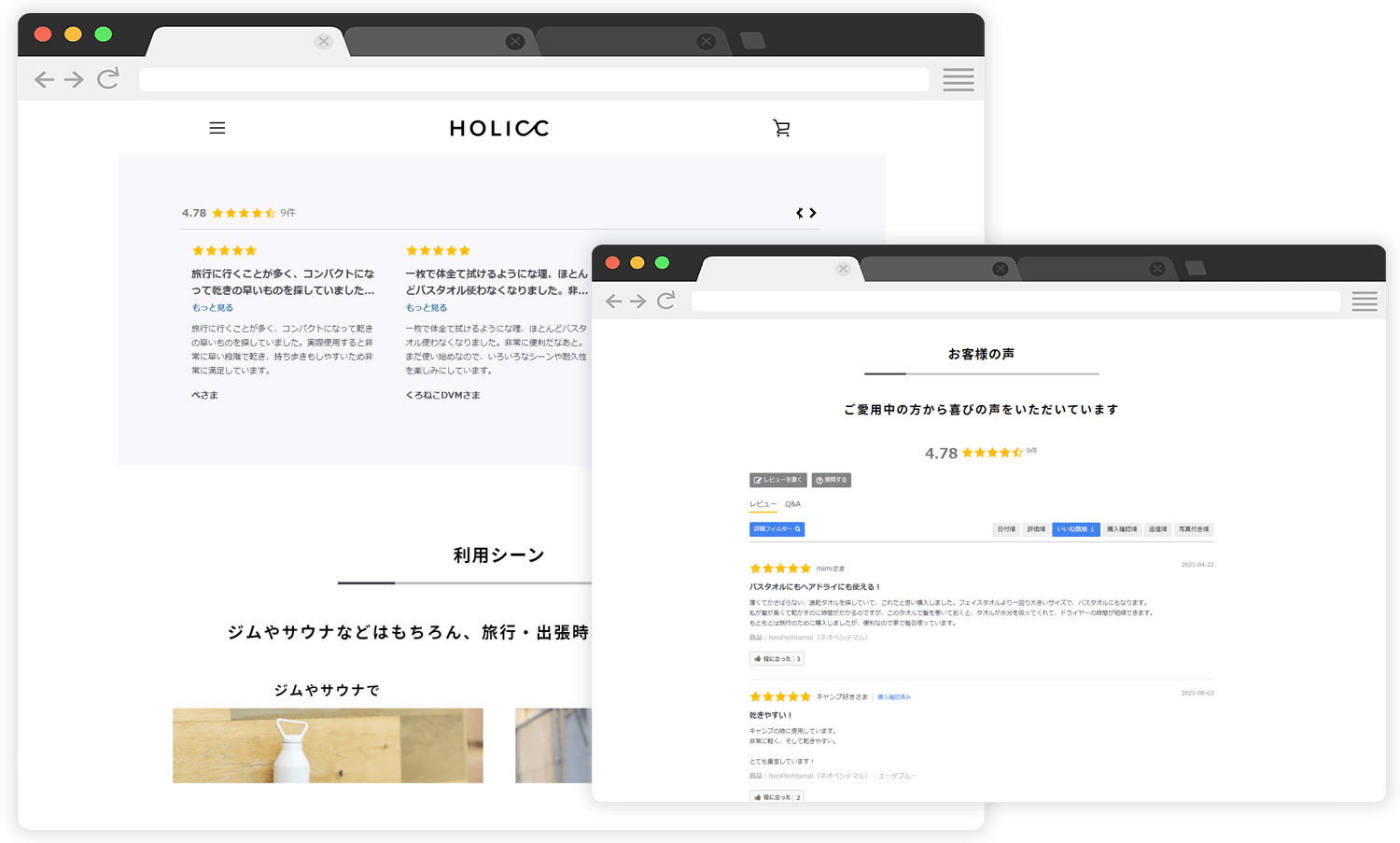
In terms of numbers, 92% of customers check reviews before making a purchase. We believe this high rate is due to reviews being displayed in two locations on the product page and the fact that reviews have been posted for every product. Including non-buyers, it appears that about 60% of all visitors to the e-commerce site view the reviews.
Do you have any examples of initiatives that utilize reviews?
We use reviews, surveys, and direct feedback to drive product improvements and new product development. For example, when launching a new T-shirt, we incorporate some of the feedback received on existing T-shirts into design improvements.
Finally, could you tell us about your future outlook and expectations?
We are considering displaying star ratings in Google Shopping ads. As for our expectations, we hope to utilize the current feature that allows reviews to be submitted via email reply to conduct surveys, and to tag the responses obtained there for use in email campaigns.
For instance, if we could solicit opinions on future product ideas and allow customers to respond via email, I believe the response rate would increase, and it would be more interactive and engaging.