At the Forefront of the AI Search Era — U-KOMI Begins Offering Support for Structured Data (in a format readable by AI and search engines) for FAQ Features and Product Q&A
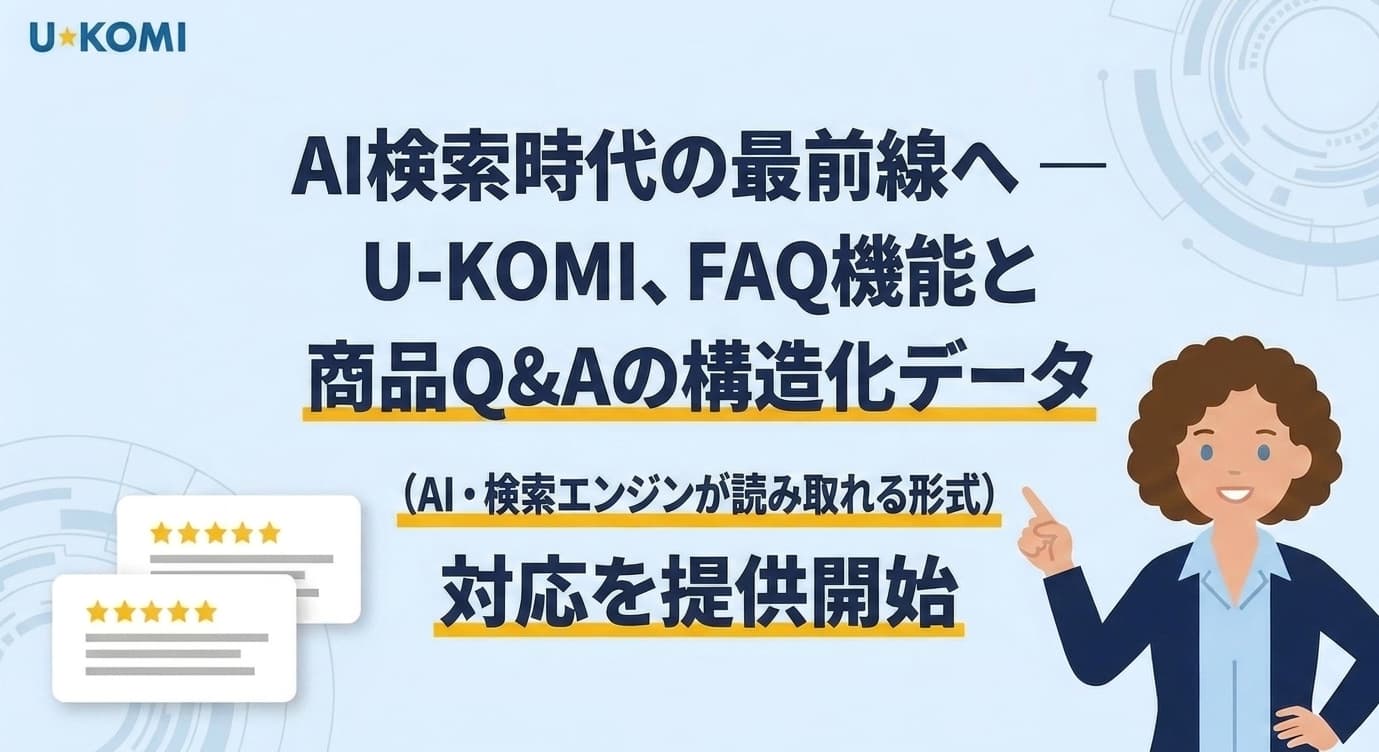
U-KOMI has launched support for structured data (a format that allows AI and search engines to accurately understand the content) for its FAQ feature and product Q&A.
This is not merely an announcement of a new feature. It is a clear statement of intent from U-KOMI: to provide more serious and faster support than any other UGC tool in Japan for “building stores that are chosen by AI.”
Search is shifting from “looking for something” to “getting answers from AI”
With the widespread adoption of AI Overview and ChatGPT search, consumer purchasing behavior has changed dramatically over the past one to two years. The era of comparing search results one link at a time is over; discovering products and brands through “answers” summarized by AI is now becoming the norm.
For e-commerce businesses, this shift means the following reality:
- Customers discover stores not by whether they rank first in search results, but by whether they are included in AI responses
- AI prioritizes and cites reliable primary sources
- Content that isn’t recognized by AI is effectively “non-existent,” no matter how carefully it’s crafted
In the world of search, alongside SEO (Search Engine Optimization), new fields such as AEO (Answer Engine Optimization), GEO (Generative Engine Optimization), and LLMO are expanding.If SEO refers to strategies for “appearing at the top of search results,” AEO refers to strategies for “being selected as the ‘answer’ to a user’s question,” and GEO refers to strategies for “being understood and cited within AI-generated answers.”FAQs and product Q&As are precisely the “questions and answers” content at the heart of AEO and GEO.
Content that isn’t read by AI is content that won’t reach customers.
For e-commerce site operators, this is no longer a “future concern”—it’s a “current reality.”
The Difference Between Stores “Cited” by AI and Those Ignored
So, what kind of information does AI trust and incorporate into its answers?
The key lies in structured data (JSON-LD). By embedding information on a page in a machine-readable format, search engines and AI can accurately understand the relationship between “this is a question” and “this is the answer.” As a result, search engines and AI can accurately understand the content, leading to it being cited in AI responses.
Another key factor is the “source” of the content.
As the internet becomes flooded with AI-generated promotional copy, both the AI itself and search engines are placing greater emphasis on “authentic interactions” between real customers and stores. As we’ve mentioned on this blog, survey results from the U.S. show that while 86% of consumers have concerns about AI recommendations, 84% trust reviews.
In other words, the stores that excel at attracting customers in the AI era are those that—
stores that have publicly shared—in a format that AI can read—a record of their sincere responses to customer questions.
U-KOMI is making AI compatibility for UGC its top priority
U-KOMI views this shift not as “a future that will eventually arrive,” but as “a reality that has already begun,” and has been advancing AI integration as the top priority in product development. In the past year alone, we have released the following features in rapid succession:
✅ AI Review Replies and AI Review Summaries
We have provided a system that uses AI to reduce the effort required for review management while ensuring we never fail to provide sincere responses to customers.
✅ “Visualizing Trust” with Trust Badges
In an era flooded with AI-generated content, we provide Trust Badges that prove “this review is genuine” from a third-party perspective. We visualize the credibility of reviews in a way optimized for the Japanese market’s purchasing culture, which places a high value on “peace of mind and trust.”
✅ Support for Structured Review Data
We output review ratings, content, and author information in JSON-LD format, successfully balancing the display of star ratings in search results (rich results) with readability for AI systems.
At the core of this is one firm conviction:
“Authentic customer voices”—such as reviews, Q&As, and FAQs—are the primary sources of information that AI trusts the most.
Anyone—and now even AI—can write ad copy and product descriptions. However, actual customer questions and their answers, along with the honest opinions of people who have used the product, are unique assets that exist only within that store. Our mission is to accurately convey these assets to AI and search engines.As a Japanese-developed UGC tool, U-KOMI is at the forefront of addressing this challenge.
For a detailed explanation of the relationship between UGC and AI search, please see this article:
[2026 Edition] Why UGC Is Important for AI Search (GEO/LLMO)
New Feature #1: FAQ Feature — Delivering “Answers” to Customers in a Format That AI Can Understand
The newly released FAQ feature allows you to easily create frequently asked questions via the admin panel and publish them to your store.
The key feature is that published FAQs are automatically generated as schema.org FAQPage structured data (JSON-LD). No specialized knowledge or manual coding is required—you’ll end up with an “FAQ page that’s easy for both people and AI to read.”
- All Handled Within the Admin Panel: Create, edit, and manage your FAQs entirely within the admin panel. Simply paste the embed code to publish them to your store.
- Automatic Structured Data Generation: The FAQs you create immediately become assets optimized for search engines and AI.
- Support for 8 languages via AI-powered translation: FAQs created in Japanese are automatically translated by AI into English, Chinese (Simplified and Traditional), Korean, Thai, French, and German. This covers AI search optimization for cross-border e-commerce.
- Blends seamlessly with your store’s design: Features a search box and category display, and supports design customization
Providing “answers” to customers not only reduces the burden on customer support but also serves as the most reliable way to disseminate information for AI search.
New Feature #2: Structured Data Support for Product Q&As — Turn Your Existing “Customer Reviews” into Search Assets for the AI Era
Another update is the addition of structured data support for the existing product Q&A feature—a format that allows AI and search engines to accurately understand the content.
“Customer questions” and “store responses” that have accumulated in your store over time—these authentic interactions can now be automatically outputted as structured data on your pages with just a single setting.
- In addition to the questions and answers, the poster’s name and date of posting are also reflected in the structured data
- This enables AI and search engines to accurately understand the questions and answers, and we expect these to be cited in AI-generated responses.
- Setup takes just one click. No new content creation is required.
Questions posted by customers are essentially a list of “what prospective buyers really want to know.” The store’s sincere responses to these questions serve as the highest-quality primary information—even for AI.
Your existing Q&A content will become a customer acquisition asset for the AI era, starting today.
Why the “FAQ × Q&A × Reviews” Trinity Works
With this update, U-KOMI has made reviews, product Q&As, and FAQs fully compatible with structured data. There is a clear purpose behind this “trinity.”
① Providing “multi-faceted” input to AI responses
AI cross-references multiple sources to generate a single answer. It draws ratings from reviews and answers to questions from Q&A and FAQs—the more multi-layered the information about your store, the higher the likelihood that it will be cited in AI responses.
② “Authentic Voices”: A Differentiator AI Cannot Create
FAQs represent the store’s official stance, while Q&As and reviews capture customers’ genuine voices. This combination creates content unique to that store—content that AI can never generate and that cannot be imitated or replicated.
③ Treating Both People and AI with Equal Sincerity
Supporting structured data is not just a “quick fix for AI.” It’s about organizing the fundamental principle of e-commerce—carefully answering customer questions—in a way that resonates with both people and AI. The greatest value lies in the fact that a single strategy can simultaneously improve CX (Customer Experience) and optimize for AI search.
Consult with us about leveraging UGC in the AI era
Staying at the forefront of change
The evolution of AI search shows no signs of stopping. New search experiences emerge every few months, and consumer behavior continues to shift.
That’s why U-KOMI promises not just to keep up with change, but to continue supporting your store right at the forefront of it. As a leading Japanese UGC tool, we’ll continue to lead the way in adapting to the AI era.
Turning “authentic customer voices” into sales in the AI era. That’s U-KOMI.
View a list of UGC case studies here:
https://u-komi.com/jirei資料のダウンロードはこちら: https://u-komi.com/document
Click here to contact U-KOMI: https://u-komi.com/contact/