“Surveys” do more than simply gather information; they also contribute significantly to increasing sales, improving customer satisfaction, and fostering brand loyalty. However, many of you may find yourselves struggling to implement effective strategies for collecting and utilizing this data.
UGC (User-Generated Content) tools, which have been gaining attention recently, offer features that can effectively support both the collection and utilization of survey data.
In this article, we’ll explain the benefits of using UGC tools for survey collection and provide specific examples of how to utilize them.
1. What Is the Significance of Survey Research?
—The Purpose of Surveys
The primary purpose of conducting surveys is to gather information that serves as the foundation for the following marketing activities:
✔︎ Identifying
needs through market research ✔︎ Improving
customer satisfaction ✔︎ Gathering feedback to improve products and services
—Authentic Customer Voices Generate New Selling Points
Gathering information through surveys is essential for understanding the “value customers need right now.” Analyzing survey results provides insights that directly lead to product and service improvements, enabling you to develop strategies that drive sales growth.
—Integrated survey collection using UGC tools
UGC tools are not just for collecting and displaying reviews. Depending on the tool, you can embed surveys into review request emails and use them to support your marketing efforts.
By collecting surveys at the same time as reviews, you can naturally gather feedback from customers.
Furthermore, by displaying survey results by category, you can provide other customers with information to help them compare and evaluate products when making their selections.
Click here for more details on UGC tools
2. Utilizing Surveys for Product Development and Service Improvement
—Clarifying and Sharing Customer Needs
When conducting surveys, isn’t the primary goal for many companies to gain insight into customers’ candid opinions and needs regarding their products and services?
By sharing the feedback collected through surveys within the company and making improvements based on it, you can not only enhance the quality of your products and services but also increase customer satisfaction.
— Enhancing Customer Loyalty
After implementing product or service improvements, customers who feel that “their opinions were taken into account” in the updated offerings are more likely to develop a deeper attachment to the brand. As a result, customer loyalty increases, leading to higher repeat purchase rates and an expanded base of brand advocates.
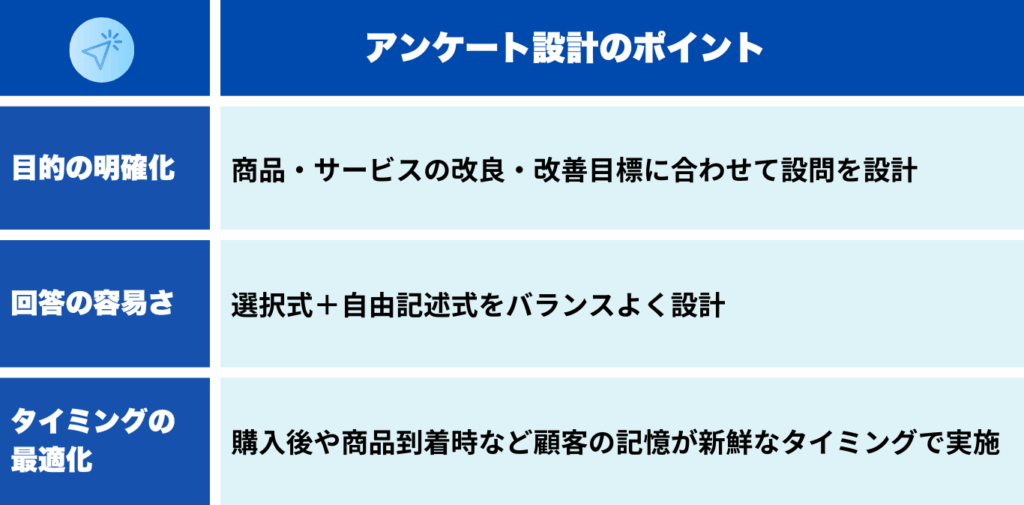
—Key Points for Effective Survey Design
To carry out product and service improvements more efficiently and effectively, it is essential to pay particular attention to the content of the survey. Careful consideration is required in various aspects, such as the survey’s purpose, target audience, timing, and administration method, as well as the design of the question formats.
For example, when determining the question formats, it is important to choose options that make it easy for respondents to answer—such as multiple-choice questions that can be completed quickly or open-ended questions designed to capture more detailed needs—ensuring that respondents can answer easily while allowing the company to gather the information it seeks.
3. Improving Targeting Accuracy
In marketing, the key to improving targeting accuracy lies in the repeated process of hypothesis testing and refinement.
—Utilizing it to Redefine Personas (*1)
Targeting is an essential process that cannot be overlooked when implementing marketing initiatives. By using surveys to investigate whether the target audience aligns with the initial hypothesis, it becomes possible to conduct an analysis.
By analyzing the age groups, genders, and purchasing motivations of customers who responded to the survey by category, you can verify whether there are any “discrepancies” with your existing target profile. If a “discrepancy” is found in the hypothesis, you should review it and develop more precise targeting strategies.
*1 Here, the term is used in the marketing context to refer to a “fictional customer profile that uses a product or service.”
—Implementation of Effective Marketing Strategies
Once the target audience is clearly defined, you can implement marketing strategies—such as adjusting advertising approaches and sales promotion channels to focus on those with actual demand—which can help maximize advertising effectiveness.
4. Strengthening Advertising Initiatives
—Utilizing Persona-Based Retargeting
It is important to launch targeted advertising campaigns aimed at personas who have responded to a greater number of surveys, while also considering retargeting ads and campaigns.
Since customer segments with a high number of survey responses and review submissions are likely to have a greater interest in the brand compared to other customers, you can retarget them with ads featuring recommended products tailored specifically to this group.
Additionally, distributing discount coupons exclusively to this customer segment can help increase purchase rates and repeat business.
[Key Points for Retargeting]
✔︎ Customized product recommendations
✔︎ Exclusive offers and coupon distribution
—Enhance ad messaging with insights from surveys
The key here is to craft your messaging carefully. By referencing phrases that appeared frequently in survey responses or including concise explanations of the benefits of using a particular product or service, you can significantly increase the appeal of your ads.
[Key Points for Strengthening Your Message]
✔︎ Incorporate frequently mentioned keywords into your ad copy ✔︎ Concisely express the benefits of using your
product or service
5. Reducing Return Costs
—Reducing Returns by Alleviating Pre-Purchase Concerns
By incorporating the information provided in the survey into a UGC tool as reviews, customers can check other customers’ real-world experiences and evaluations before making a purchase.
Since customers can learn about the actual user experience before purchasing, the “discrepancy” they feel upon receiving the product is minimized, which in turn reduces the number of cases leading to returns.
For brands, this reduces return costs; for customers, it minimizes disappointing shopping experiences, leading to improved customer satisfaction and, ultimately, greater trust in the brand.
—Example of Survey Data Collection in the Apparel Industry
✔︎ Age ✔︎ Fit ✔︎
Gender ✔︎ Warmth
✔︎ Height ✔︎ Usual Size
✔︎ Body Type ✔︎ Size
Purchased ✔︎ Thickness ✔︎ Occasions for Use
In the apparel industry, creating categories such as fit, usual size, and height makes it easier for customers to reference opinions from people with similar attributes, thereby reducing the workload associated with returns caused by incorrect sizing or discrepancies between the product and the customer’s expectations.
Click here for survey examples from the apparel industry
—Example of survey data collection in the food industry
✔︎Age Group ✔︎Ease of
Drinking ✔︎Gender ✔︎Ease
of Eating✔︎Frequency of Purchase ✔︎Satisfaction✔︎Likes
and Dislikes ✔︎Smell ✔︎Purpose
of Purchase ✔︎Packaging✔︎Recommendation
Level
In the food industry, creating categories such as packaging—which is a key hygiene concern—and purchase purposes (e.g., gifts) makes it easier to visualize actual usage scenarios and helps alleviate concerns among new customers.
Click here for survey examples from the food industry
—Example of Survey Data Collection in the Beauty Industry
✔︎Age Group ✔︎Skin
Concerns ✔︎Gender ✔︎Duration
of Use ✔︎Skin Type ✔︎Satisfaction
✔︎Recommendation Level ✔︎Reason
for Trying the Product ✔︎Perceived Effectiveness ✔︎Usage Scenarios
In the beauty industry, creating categories such as skin type and skin concerns makes it possible to display reviews and survey results from the customer’s perspective, making it easier for customers to choose products based on their specific skin concerns.
Click here for survey examples in the beauty industry
Summary: Turning Surveys into Results
In this article, we’ve introduced key strategies—including the use of UGC tools—for turning survey data into increased sales.
Surveys are not merely a means of collecting data; they are a vital tool for gaining insights that determine the success or failure of your marketing efforts.
The UGC tool “U-KOMI” allows you to collect custom questions—or surveys—at the same time as reviews, improving response rates and streamlining data utilization. Make effective use of surveys to drive sales growth in various areas, such as product improvement, advertising enhancement, and reducing returns.
U-KOMI is a UGC (User-Generated Content) tool designed to collect and utilize customer feedback. By using this tool, you can not only display reviews attractively on your e-commerce site and leverage Instagram content to improve conversion rates (CVR), but it also includes features that allow you to utilize reviews—a valuable information asset—in real time.
Furthermore, U-KOMI features an AI function called U-KOMI AI. U-KOMI AI is a suite of smart AI functions that performs sentiment analysis, keyword extraction, AI score calculation, and automated replies for reviews. From
customer support to service and product improvements, it takes your marketing to the next level.
Click here for more details on U-KOMI AI
Why not consider implementing survey initiatives using UGC tools?
View a list of UGC use cases here: https://u-komi.com/jirei
If you’d like to review U-KOMI’s features, implementation case studies, and pricing plans all at once, please download our service brochure.
Click here to contact U-KOMI: https://u-komi.com/contact/