Reviews received are used as a reference for the appealing content of advertisements. Improved products also increase CVR and retention rates.
Case Study Interview
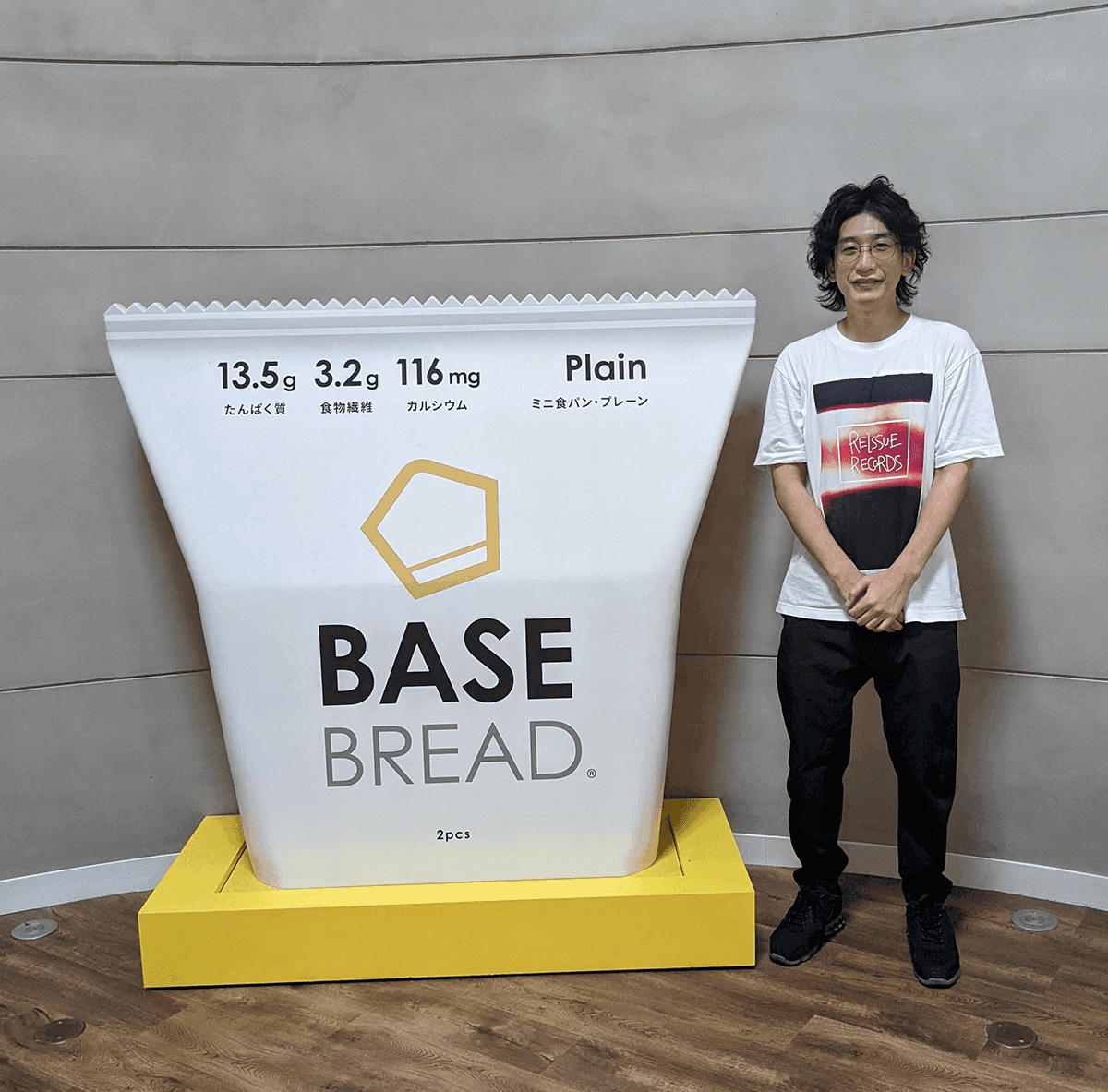
Base Food Co., Ltd. develops and sells "complete nutrition foods" such as bread and cookies packed with essential nutrients. Recognizing the importance of word-of-mouth in their marketing efforts, the company decided to implement U-KOMI to support its growth. We spoke with 大橋様, who is in charge of U-KOMI operations at the company, to learn about the reasons behind the implementation and the results achieved.
Developing and Selling "Complete Nutritional Foods*" Centered on Staple Foods
First, could you tell us about your business?
Our mission is “Innovating staple foods to make health a given.” We aim to help people achieve better diets and health by creating an environment where they can easily obtain nutrients from the staple foods they eat every day. In terms of products, we develop foods in the staple food category and related areas, such as bread, noodles, and cookies. We plan to continue developing and selling a variety of foods, including various staple foods, in the future.
Our business model involves selling products via a subscription service on our own e-commerce site, as well as through other e-commerce platforms such as Amazon and Rakuten. Since last year, we have also been distributing to retail stores such as convenience stores, creating an environment where customers can easily purchase our products anywhere. We are focusing our efforts on both e-commerce and physical stores, expanding our business to ensure our products are accessible everywhere as part of the “food infrastructure.”
Currently, the majority of our sales come from our own e-commerce site, but we aim to create a model where customers purchase from other channels while also subscribing to our service, encouraging purchases through both channels.
*Based on nutrient labeling standards, this product contains at least one-third of the daily recommended intake for all nutrients (excluding fats, saturated fats, carbohydrates, and sodium, for which excessive intake from other meals is a concern) in a single serving.
What are the differences and strengths of your product compared to other companies selling complete nutrition meals?
We place great importance on the questions: “What does it mean for a product to serve as a staple food?” and “What does it mean to eat it every day?” Therefore, we design our nutritional balance based on Ministry of Health, Labour and Welfare standards, and we develop flavors with the goal of creating “basic tastes that won’t get boring even when eaten daily.”
Furthermore, since we keep daily consumption in mind, various departments are working hard to offer our products at the most affordable prices possible.
We chose U-KOMI for its flexibility in adapting to changes in our in-house e-commerce platform
Could you also tell us what prompted you to consider implementing a review tool and the background behind that decision?
As is commonly understood in marketing theory, word-of-mouth has a tremendous impact. However, while gathering customer feedback itself isn’t difficult, developing an in-house system capable of synchronizing that data in bulk is quite challenging. Considering these factors, we felt it would be better to collaborate with an external company rather than develop the system ourselves, which led us to search for a tool.
Since we are still a new company, we felt it was important to have customer reviews so that customers would recognize our products as safe and reliable.
Was the fact that you felt you could implement it faster by finding a partner rather than developing it in-house also a factor in your decision to adopt the tool?
Another reason was that we didn’t know the right way to present the tool to maximize its effectiveness. It wasn’t just about the features; developing the tool in-house was difficult in and of itself. So, rather than comparing it to in-house development, the reality is that we felt the probability of success would be higher by partnering with an external company, simply because we lacked the necessary know-how.
With other review tools available, what was the deciding factor in choosing U-KOMI?
One factor was the high degree of flexibility in configuration. Since our product lineup will continue to expand, our website’s page layouts will also evolve, so it was crucial that the tool’s system could adapt flexibly to these changes. We felt that a tool capable of evolving alongside our company—one that could be refined and improved in detail to accommodate these changes—was preferable to a tool that was simply “complete” from the start, which is why we chose U-KOMI.
Another key factor in choosing U-KOMI is its ability to send review request emails immediately after a product is added to the cart and payment is processed. After all, the moment right after a purchase is the best time to capture customers’ attention.
What results have you seen since implementing U-KOMI?
A major benefit is that we can use customer feedback as a reference when creating advertising campaigns. For example, we can see evaluations beyond just the taste of the product—such as “You can eat it easily with one hand” or “It tastes great when heated in the microwave”—which helps us decide how to promote the product or encourage purchases.
Another benefit is that it serves as a replacement for in-house surveys. Sending surveys ourselves requires a lot of preparation, and doing so daily or weekly isn’t practical. With U-KOMI, we can semi-automatically collect reviews from customers who have purchased the product. This allows us to receive timely feedback on aspects we might otherwise overlook, such as “The oxygen absorber is hard to peel off” or “The curry flavor tastes better when heated in the microwave.”
From a product development perspective, by using these reviews to make the oxygen absorbers easier to remove or adding information like “Tastes better when heated in the microwave” to the packaging, we’ve improved our products—which has led to a secondary effect of increased conversion rates (CVR) and customer retention.
We’ve found that while it’s difficult to elicit such specific feedback on individual products through targeted survey questions, collecting it via reviews is highly effective.
Finally, please let us know if you have any future outlooks or requests.
We intend to treat the reviews we’ve collected as a valuable asset and utilize them more broadly for marketing and product development. Currently, we display reviews on product detail pages on our website, but we’d like to select a few to feature as customer testimonials on our landing pages designed to drive conversions. If we can implement such flexible design options, I believe it will help us launch new initiatives and allow customers to make purchases with greater confidence.
Also, it would be even better if the UX were designed so that even team members who aren’t very tech-savvy could easily navigate the admin panel.