![[What Is VOC?] How to Effectively Collect and Utilize Customer Feedback Using UGC Tools](/_next/image?url=https%3A%2F%2Fimages.microcms-assets.io%2Fassets%2F52802991b92c45338b7478be9a902d36%2F2da06484f41a4fd1b3186f5e1847cc65%2Fabout-voc.jpg&w=3840&q=75)
VOC (Voice of the Customer) is a critical information asset that should be leveraged in the operation of e-commerce sites and brick-and-mortar stores to improve products and services and enhance the customer experience.
In this article, we will systematically cover everything from the basics of VOC to strategies utilizing UGC tools.
1. An Introduction to VOC: How to Grow Your Business by Leveraging Customer Feedback
—What Is VOC (Voice of the Customer)?
VOC stands for “Voice of the Customer” and refers to the opinions, requests, and evaluations that customers provide to a company. It includes information gathered through surveys, customer support, call centers, and interviews.
—Why Is VOC Important?
It is crucial to design products and services from the customer’s perspective. However, when companies proceed with planning based solely on their own brand perspective, a “gap” between that perspective and the user’s perspective often arises.
Since VOC reflects customer opinions regarding the “discrepancies” between the company and its customers—discrepancies that cannot be fully grasped from within the brand—it can be utilized as data that provides insights for improvement. By listening to the actual voices of customers, companies can enhance service quality and the value of the customer experience, which will ultimately lead to improved customer satisfaction (CS) and LTV.
2. Maximizing the Value of Customer Feedback! The Differences and Synergies Between VOC and UGC
—The Difference Between VOC and UGC
VOC refers to customer feedback that companies actively collect. On the other hand, UGC (User-Generated Content) is a general term for content created voluntarily by ordinary users and posted on social media, review sites, and word-of-mouth platforms.
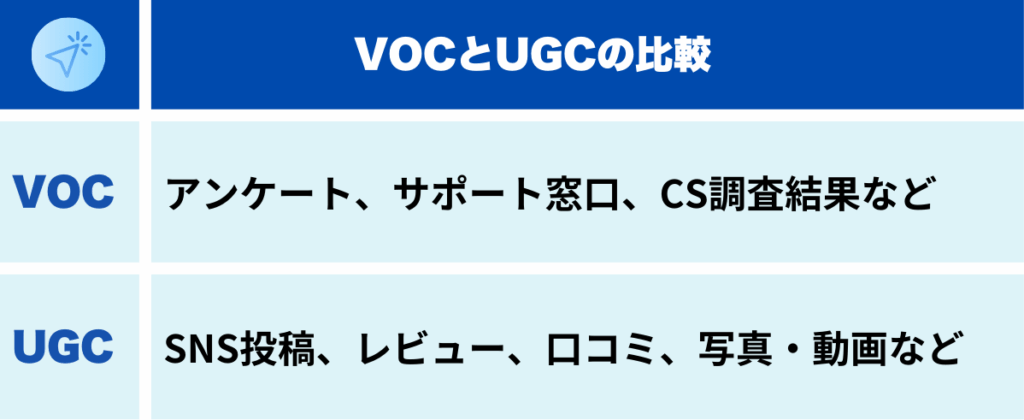
—The Synergy Between VOC and UGC
By actively collecting VOC through departments such as call centers and utilizing it to improve products and services, while simultaneously identifying new selling points from UGC posted by customers in the form of reviews and social media content, companies can leverage VOC and UGC synergistically to create effective marketing strategies.
For example, customer feedback received by call centers often reflects “requests” for product or service improvements or “questions” regarding usage. On the other hand, while UGC may also include such “requests” and “questions,” it often highlights sentiments such as:
✔︎ “I really felt the product’s effects,
” ✔︎ “I’d recommend
this to my friends,” ✔︎ “I felt even better results when I used it this way,”
Since users can casually post reviews, images, and videos with the same ease as sharing with family and friends, UGC is characterized by communication-based customer feedback—such as a sense of “sharing” or “suggestions.” It includes real-life usage examples and suggestions from the consumer’s perspective, making it compelling and persuasive content.
By collecting both positive and negative customer feedback from multiple angles and incorporating it into your website, products, and services, you can improve customer satisfaction and aim to increase your conversion rate (CVR).
3. Effective VOC Strategies Using UGC Tools
—What Are UGC Tools?
UGC tools are designed to collect, analyze, and publish not only text reviews and word-of-mouth feedback but also visual content created and posted by users via social media and other platforms. By analyzing this data—rather than simply displaying reviews—you can develop strategies based on deeper customer insights, adding greater depth to your marketing efforts.
—Addressing User Concerns Through Customer Voices
By publishing UGC collected from reviews and visual UGC content gathered from social media on your company’s e-commerce site, users can learn the information they want about products and services through third-party testimonials, which helps reduce bounce rates and improve conversion rates (CVR).
Learn more about visual UGC here
—Achieving One-to-One Customer Service
By utilizing UGC tools, customers can easily post reviews, and brands can respond to those reviews, enabling one-to-one communication on the e-commerce site that closely resembles the face-to-face customer service provided in physical stores. This can help build trust in the brand and foster customer loyalty.
Click here for more details on one-to-one customer service
―Utilizing Surveys in Review Requests | Streamlining VOC Collection
Some UGC tools include a feature that allows you to embed surveys in review request emails. This makes it possible to include surveys like the ones listed below in your review request emails, enabling you to implement survey initiatives—which are part of VOC strategies—simultaneously with UGC collection. As a result, you can collect reviews and conduct VOC surveys at the same time.
[Example Survey Questions]
✔︎ Please rate how likely you are to recommend this product.
✔︎ Please rate your satisfaction level.
✔︎ Please tell us the purpose of your purchase.
By using multiple-choice questions, users can submit responses easily without having to spend time thinking about their answers.
Click here for more details on survey collection
―Increase Response Rates with Rewards
By including a multi-choice survey in review request emails—designed for easy submission—and offering rewards such as points or coupons, you can increase customer response rates and collect more VOC.
―Reducing the Burden on Both the Brand and Customers
Using a UGC tool to collect and display reviews not only reduces the number of inquiries to customer support but also cuts down on the time spent creating surveys, thereby streamlining operational workloads.
For customers, this reduces the time spent searching for information and the mental and time-related burdens associated with making inquiries.Inquiries via phone or email require time to formulate the inquiry, and customers may leave the site or complete their purchase without having their questions or concerns about products or services resolved. However, by displaying third-party reviews, you can reduce the burden and stress involved in resolving these questions and provide a smoother purchasing experience.
—The Importance of VOC and UGC in AI Search
Recently, the use of AI search has been rapidly expanding in the realm of online shopping as well. Reviews and social media posts collected via UGC tools serve as crucial indexing material that helps AI more easily guide users to appropriate products or pages in response to their queries. VOC and UGC can also be considered effective in building traffic pathways via AI.
Summary
In this article, we have systematically introduced everything from the basics of VOC to strategies utilizing UGC tools.
By utilizing UGC tools, you can collect and leverage customer feedback—which couldn’t be obtained through traditional surveys or customer support alone—in a more efficient and reliable manner by incorporating insights from both VOC and UGC.
U-KOMI is a UGC (user-generated content) tool designed to collect and utilize customer feedback. By using this tool, you can not only display reviews attractively on your e-commerce site and improve conversion rates (CVR) by leveraging Instagram content, but also implement features that allow you to utilize reviews—a valuable, dynamic information asset—in real time.
Furthermore, U-KOMI incorporates an AI feature called U-KOMI AI. U-KOMI AI is a suite of smart AI functions that performs sentiment analysis, keyword extraction, AI score calculation, and automated replies for reviews. From
customer support to service and product improvements, it takes your marketing to the next level.
Click here for more details on U-KOMI AI
Why not consider implementing a UGC tool that aligns with your company’s marketing strategies?
View a list of UGC use cases here: https://u-komi.com/jirei
If you’d like to review U-KOMI’s features, implementation case studies, and pricing plans all in one place, please download our service brochure.
Contact U-KOMI here: https://u-komi.com/contact/