Since the emergence of search engines equipped with generative AI—such as AI Overview—various marketing strategies, including SEO for content marketing, have likely been reevaluated.
While various generative AI services—such as ChatGPT and Bing AI—are available, in this article, we’ll explain Google’s “AI Overview,” touching on its relationship with user-generated content (UGC).
1. What Is AI Overview? Google’s Latest Search Experience Powered by Gemini
—What Is AI Overview?
AI Overview is a feature that leverages Gemini, a generative AI model designed to select and provide higher-quality information from the search index. Prior to its official announcement as AI Overview, it was offered as SGE (Search Generative Experience) for experimental purposes.
It is a new search experience that instantly displays high-quality answers tailored to the user’s search intent. Unlike traditional search results, which list links, the AI synthesizes information and generates and presents answers in a question-and-answer format.
—An Evolved Search Experience: Multimodal Support
In addition to traditional text search, Google AI Overview supports a variety of search methods, including:
✔︎ Image search (e.g., using a photo to look up details about a product or service)
✔︎ Voice search (e.g., asking a question verbally and receiving an immediate AI response)
✔︎ Video search (e.g., filming a home appliance to look up product information)
It provides an intuitive experience that helps users overcome “search barriers” even in situations where it’s difficult to put thoughts into words.
Another notable feature is that access and traffic are reflected in Google Search Console (*1).
*1 Google Search Console allows you to measure your site’s search traffic and ranking on Google’s SERP (Search Engine Results Page). It includes features such as the ability to view the queries users entered to access your site, as well as the capability to analyze metrics like impressions and clicks.
2. How Is AI Overview Transforming Marketing Strategies? New Strategies for the Zero-Click Era
With the introduction of Google’s AI Overview, user search behavior and companies’ web traffic acquisition strategies are beginning to change significantly.
—An Era of Obtaining Information Without Visiting a Site
A key feature of AI Overview is that, when users search via Google Chrome, their search results are summarized and consolidated by generative AI and displayed at the top of the page.
For users, this offers the following benefits:
✔︎ Obtain
the information they want without visiting a website ✔︎ Instantly grasp summaries from multiple sites
Since AI Overview’s responses include links to the source websites, users can click through to those links to obtain further information.
On the other hand, since AI Overview provides summaries of information extracted from various websites, when answers—such as definitions or concepts—are available directly within AI Overview, there is no longer a need to navigate to the linked sites.
While this reduces the effort required for users—often just a single click—and provides a more comfortable search experience, SEO professionals aiming to increase website traffic face a potential decline in site visitors, forcing them to adopt new strategies.
—Is SEO Alone Insufficient? Generative AI Countermeasures = LLM-based AI Is Now Necessary
Traditional SEO has focused on increasing organic traffic by achieving top search rankings to meet marketing goals such as improving conversion rates (CVR).
However, with the advent of AI Overview, so-called “zero-click searches” have begun to gain traction, and relying solely on SEO to drive traffic to a site is becoming insufficient. Consequently, attention is turning to Large Language Model Optimization (LLMO) (*2). It has become necessary to implement LLMO and create content that is “selected” by AI.
*2 This aims to optimize for search engines equipped with generative AI.
It is cited as a strategy for getting content cited by generative AI.
For more on “how to implement LLMO” as a strategy for AI Overview, please refer to this article
3. What Are AI Overview and LLMO? Search Strategies for the “Generative AI Era” That SEO Alone Cannot Achieve
—LLMO Is the Next-Generation Content Marketing Strategy
In AI Overview, when search results are displayed, site links appear as the source of the information. Moving forward, the key to content marketing will not only be implementing measures to “rank highly in search results”—the goal of SEO—but also implementing LLMO strategies to “be selected for generative AI responses.” In other words, it is necessary to implement LLMO, the next-generation content marketing strategy.
—What Are the Specific Methods of LLMO? Content Design That Addresses Search “Intent” Is the Key
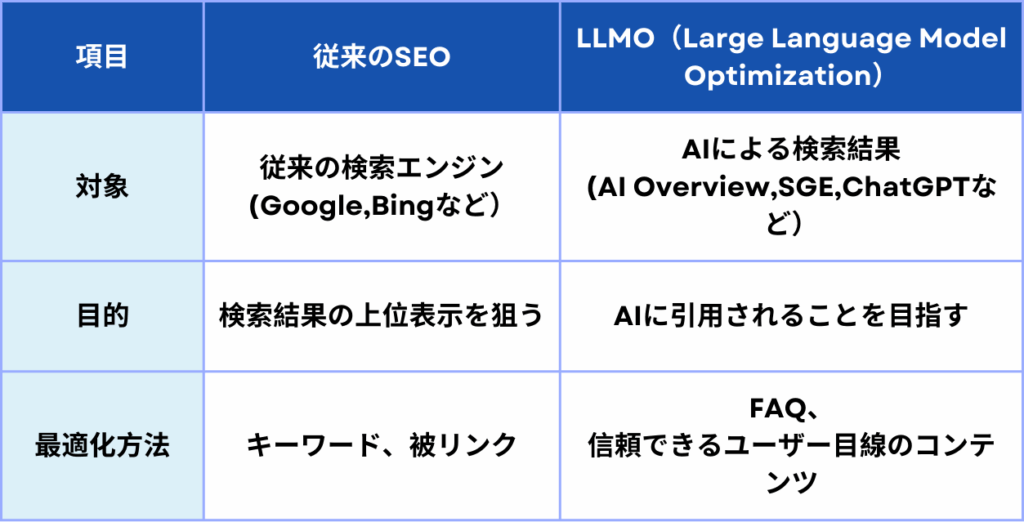
While SEO focuses on optimizing for search engine ranking algorithms, LLMO focuses on optimizing for AI-powered generative engines.
While user search keywords—as in SEO—remain important, LLMO is said to prioritize the user’s search intent when determining which results to display.
Therefore, specific strategies include publishing brand-specific information, providing answers designed from the user’s perspective, utilizing reliable sources, incorporating concrete figures and data, and offering an FAQ section.
4. What Is the Relationship Between AI Overview and UGC (User-Generated Content, such as Reviews)? User Voices Hold the Key to SEO and LLMO
—Why Is UGC Effective for SEO and LLMO?
Google’s Search Quality Rating Guidelines frequently cite E-E-A-T (*3) as an evaluation criterion.
What is E-E-A-T?
✔︎ Experience
✔︎ Expertise
✔︎
Authoritativeness ✔︎ Trustworthiness
Previously, the evaluation criteria consisted of the three E-A-T factors excluding “Experience,” but “Experience” was later added.
User-generated content (UGC), such as customer testimonials and reviews, is considered effective for both LLMO and traditional SEO. UGC represents “authentic user voices” and is easily recognized as information from the user’s perspective.
UGC, such as reviews and testimonials, consists of raw, unfiltered feedback from users who have actually used the products or services. Google tends to view this as a “highly reliable” and useful source of information for users, making it an integral part of both SEO and LLMO.
*3 Elizabeth Tucker. “Latest Updates to the Quality Rating Guidelines: Adding the ‘E’ for Experience to E-A-T.”December 15, 2022, https://developers.google.com/search/blog/2022/12/google-raters-guidelines-e-e-a-t?hl=ja, (accessed February 27, 2025).
—Is UGC Effective for User Journey Design in the Zero-Click Era? How to Leverage User Reviews to Balance SEO and LLMO
Relying solely on objective information may result in the search experience ending with a “zero-click” result; however, authentic user testimonials and reviews provide information from the user’s perspective, so publishing them can improve a site’s reputation. Since this approach can also spark interest in reviews beyond those displayed in search results, users are more likely to go out of their way to visit your company’s website.
Since UGC is effective not only for LLMO but also for SEO, it’s no exaggeration to say that using these testimonials and reviews as a hook to implement LLMO and SEO constitutes a new content marketing strategy.
Additionally, since some UGC tools include an FAQ feature, using such tools also constitutes LLMO.By replying to and publishing reviews posted by customers, you can share content from the customer’s perspective with other customers, which can be leveraged by search engines as valuable information. At the same time, this serves as an effective SEO strategy.
Summary: The New Norm in the Era of AI Overview—What Is the UGC Utilization Strategy That Supports SEO and LLMO?
In this article, we’ve explained Google’s “AI Overview” feature, touching on its relationship with UGC.
AI Overview is a groundbreaking feature that significantly transforms the search experience. Since AI summarizes and presents the information users are looking for directly on the search results page, we have entered an era where traditional SEO alone is no longer sufficient.
Amid this shift, a new concept—Generative Engine Optimization (LLMO)—is gaining increasing importance. User-generated content (UGC), such as customer testimonials and reviews, proves highly effective for both LLMO and SEO. By implementing a UGC management tool, businesses can reap various benefits, including the ability to leverage UGC marketing strategies and improve the efficiency of UGC management.
U-KOMI is a UGC (User-Generated Content) management tool designed to collect and utilize customer feedback. By using this tool, you can not only display reviews attractively on your e-commerce site and improve conversion rates (CVR) by leveraging Instagram content, but also utilize reviews—a valuable, dynamic information asset—in real time through built-in features.
Furthermore, U-KOMI incorporates an AI feature called U-KOMI AI. U-KOMI AI is a suite of smart AI functions that performs sentiment analysis, keyword extraction, AI score calculation, and automated replies based on reviews. From
customer support to service and product improvements, it takes your marketing to the next level.
Click here for more details on U-KOMI AI
As we look toward the new LLMO era, we encourage you to consider the benefits of implementing a UGC tool and explore how it can align with your company’s marketing strategies.
View a list of UGC use cases here: https://u-komi.com/jirei
If you’d like to review U-KOMI’s features, implementation case studies, and pricing plans all at once, please download our service materials.
Click here to contact U-KOMI: https://u-komi.com/contact/